One week, one loop: this 7-day Oman itinerary takes you from Muscat to the forts of Nizwa, up Jebel Akhdar, into the dunes of Wahiba Sands, to Wadi Bani Khalid and the turtles of Ras al Jinz, then back along the coast past Wadi Shab and the Bimmah Sinkhole — with driving times, official opening hours, entry fees, car hire versus tours and a cost table in Omani rials.
Seven days is the sweet spot for a first trip to Oman. It is enough for a great mosque, mud-brick forts, a mountain plateau two kilometres up, a night in the dunes, nesting turtles and a canyon of turquoise pools — without living in the car. The trick is the order: this 7-day Oman itinerary runs as one loop, so you never drive the same road twice.
Below you get the route day by day with verified driving distances and times, the official opening hours of the Grand Mosque and Nizwa Fort, the entry fees you will actually pay, whether to hire a car or join a tour, and a cost table in Omani rials — plus the best months and how to add Musandam or Salalah. Each day links to the matching SKY LINE TRAVEL tour.
Checked on 7 November 2026. Opening hours and turtle-reserve fees come from the official sites; other entry fees, camp prices and car-hire rates are what operators and recent visitors reported this autumn and can change without notice. Driving times are for normal traffic and dry roads. Our tours are open for enquiries now — dates and prices are confirmed by our desk when you ask.
One week in Oman at a glance
- ≈ 900 km
- The whole loop, Muscat back to Muscat
- 8–11 am
- Grand Mosque hours for non-Muslim visitors, Saturday to Thursday
- 8 am – 8 pm
- Nizwa Fort, daily (Friday break 11:30–1:30)
- OMR 12
- Ras al Jinz turtle viewing, tourist adult
- 4×4 only
- Police checkpoint on the Jebel Akhdar road
- Oct – Apr
- The best months for a road trip
The 7 day Oman itinerary at a glance
| Day | Route | Driving | Sleep in |
|---|---|---|---|
| 1 | Muscat: Grand Mosque, Muttrah, Old Muscat | City only | Muscat |
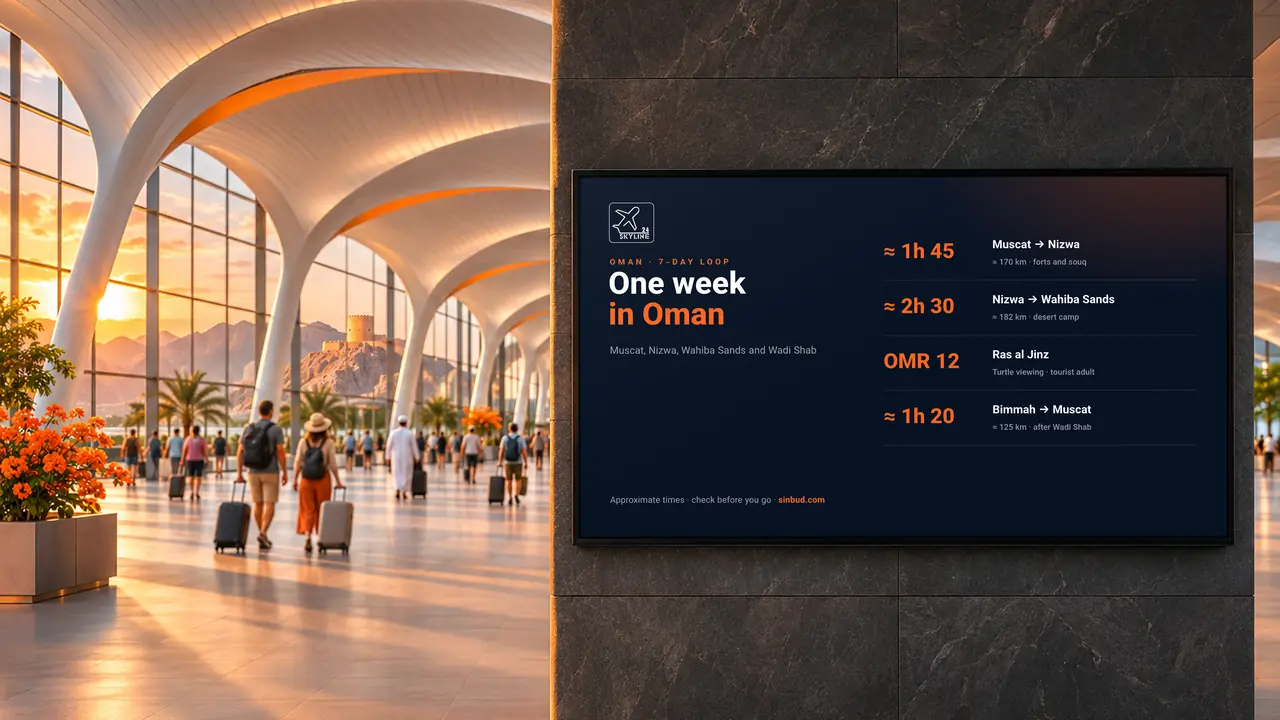
| 2 | Muscat → Nizwa, Bahla and Jabreen | ≈ 170 km, 1 h 45 + ≈ 55 km for the forts | Nizwa |
| 3 | Nizwa → Jebel Akhdar (Saiq plateau) | ≈ 55 km, about 1 h | Jebel Akhdar or Nizwa |
| 4 | Jebel Akhdar → Wahiba Sands (Bidiyah) | ≈ 235 km, 3 – 3 h 30 | Desert camp |
| 5 | Wahiba → Wadi Bani Khalid → Sur → Ras al Jinz | ≈ 44 km + 120 km + 50 km | Ras al Jinz or Sur |
| 6 | Ras al Jinz → Wadi Shab → Bimmah → Muscat | ≈ 100 km + 30 km + 125 km | Muscat |
| 7 | Muscat: dolphins, beach or islands, then fly | City only | — |
We run the loop anti-clockwise — mountains first, coast last — because finishing with Wadi Shab means your last big day ends about 90 minutes from Muscat, not three hours away in the desert. If your flight lands late, simply swap Day 1 and Day 7: the Grand Mosque only opens to visitors in the morning anyway.
Days 1–2: Muscat and the forts of Nizwa
Day 1 — Muscat: the Grand Mosque, Muttrah and Old Muscat
Start early at the Sultan Qaboos Grand Mosque. According to Experience Oman, the Ministry of Heritage and Tourism’s site, non-Muslim visitors are welcome Saturday to Thursday between 8:00 and 11:00 am, and it is closed to visitors on Friday. Give it an hour and a half. After lunch drive to Muttrah for the corniche and the souq, then on to Old Muscat for Al Alam Palace and the twin forts of Jalali and Mirani, which you see from outside. End with sunset on a dhow — the whole day is our Muscat city and dhow cruise tour.
- Dress code: shoulders and knees covered for everyone; women also cover their hair, with loose clothing to the wrists and ankles. Abayas and scarves are available at the entrance.
- The fee question: the official tourism page lists an admission fee of OMR 8, while many recent visitors report free entry. Carry the cash and you will not be caught out.
- Where to stay: for a first visit most people pick the beach and Opera House area or the old harbour. Our guide to the best areas to stay in Muscat compares them, and you can check live rates on our Muscat hotels page.
Day 2 — Nizwa, Bahla and Jabreen
The motorway to Nizwa takes about 1 h 45 (roughly 170 km). Go straight to Nizwa Fort with its great round tower: the fort’s own site gives daily hours of 8:00 am to 8:00 pm, with a Friday break between 11:30 am and 1:30 pm. Tickets are sold at the reception; recent visitors paid about OMR 5 as adult tourists. In the afternoon drive 44 km to Jabreen Castle, famous for its painted ceilings, then 9 km to Bahla Fort, a UNESCO World Heritage site. If Day 2 falls on a Friday, be at the Nizwa souq early for the livestock market. Prefer not to drive? Our Nizwa and Bahla forts tour covers all three.
Days 3–4: up to Jebel Akhdar, down to the Wahiba dunes
Day 3 — Jebel Akhdar, the Green Mountain
From Nizwa it is about 25 km to the town of Birkat Al Mouz, then roughly 30 km of steep switchbacks up to the Saiq plateau at around 2,000 metres. Up here summer days stay near 27–30°C while the coast passes 40°C, and winter nights can drop to a few degrees above freezing — bring a jacket from December to February. Walk the terraced villages of Al Ayn and Ash Shuraija along the falaj channels, and in March and April catch the Damask rose harvest. Our Jebel Akhdar tour includes the 4×4 and a driver who knows the road.
Only 4×4 vehicles may drive up. A Royal Oman Police checkpoint at the foot of the mountain road turns back ordinary cars and two-wheel-drive SUVs. Carry your licence, passport and the car’s registration card. If you have a saloon, leave it at the car park below the checkpoint, where 4×4 drivers wait to take visitors up, or ask your mountain hotel about a pick-up.
Day 4 — Wahiba Sands: dunes, sunset and a night in camp
Come down the mountain after breakfast and head east through Izki and Ibra to Bidiyah, the gateway to the Wahiba Sands (also called Sharqiya Sands) — about three to three and a half hours in all. Plan to arrive by mid-afternoon: the light turns the sand deep orange in the last hour before sunset, and that is when you want to be on top of a dune. Our Wahiba Sands desert camp tour does the 4×4 dune drive for you and adds the swim at Wadi Bani Khalid the next morning.
- Getting to camp: with a 4×4 and some sand-driving experience you can drive in on the main tracks. In a saloon, park in Bidiyah and let the camp collect you — ask about the transfer price when you book, as it varies a lot.
- Prices: simple Bedouin-style camps start around OMR 15–25 per person with dinner and breakfast; Desert Rose Camp lists tents from OMR 65 a night, and luxury camps go well beyond OMR 150.
- Cash: many camps take only cash and there is no ATM in the dunes. Fill the tank and take out rials in Bidiyah.
Days 5–7: Wadi Bani Khalid, the turtles of Ras al Jinz and Wadi Shab
Day 5 — Wadi Bani Khalid, Sur and the turtle beach
Wadi Bani Khalid is only about 44 km from Bidiyah (an hour) and is the easiest of Oman’s wadis: a short walk leads to green pools under palm trees. Entry has mostly been free this year, though one guide reports a small fee, so carry a few coins. From there it is about 120 km (1 h 30) to Sur, the old dhow-building town, and another 50 km to Ras al Jinz. The Ras al Jinz Turtle Reserve runs a night viewing at 9:00 pm (arrive by 8:30) and a dawn viewing at 5:00 am (arrive by 4:45). Tourists pay OMR 12 per adult and OMR 6 per child aged 6–12; Oman residents pay OMR 8, Omani citizens OMR 3. Sleep at the reserve, where both viewings are in the room rate, or in Sur.
Day 6 — Wadi Shab and the Bimmah Sinkhole
Drive back through Sur and up the coast highway to Tiwi, about 50 km from Sur. Wadi Shab begins with a short boat ride across the first pool — about OMR 1 per person, paid in cash — then a 45–60 minute walk between canyon walls to a chain of turquoise pools. Strong swimmers can reach a waterfall inside a cave. Allow four hours and start early. Thirty kilometres on, the Bimmah Sinkhole in Hawiyat Najm Park is a short stop, usually free, for a swim in clear green water, and from there Muscat is about 125 km (1 h 20) away. This day is our Wadi Shab and Bimmah Sinkhole tour, with hotel transfers from Muscat.
- Wear water shoes and carry your phone in a dry bag.
- Dress respectfully: villagers live in the wadi — swim in shorts and a T-shirt, not a bikini.
- Never enter a wadi when rain is forecast in the mountains: flash floods arrive fast.
Day 7 — a slow last day in Muscat
Keep the final day light: take a morning boat to look for dolphins off the Muscat coast — our Muscat dolphin watching tour takes two to three hours — or spend the whole day snorkelling around the protected Daymaniyat Islands. If you swapped days because you landed late, this is your Grand Mosque morning. For check-in times and what to expect when you fly out, see our Muscat airport guide.
Entry fees and opening hours along the route
| Sight | Opening hours | Adult tourist fee |
|---|---|---|
| Sultan Qaboos Grand Mosque | Sat–Thu 8:00–11:00 am for non-Muslims | OMR 8 listed; often reported free |
| Nizwa Fort | Daily 8 am–8 pm; Fri break 11:30–1:30 | About OMR 5 |
| Jabreen Castle | About 7:30 am–9 pm daily | About OMR 3 |
| Bahla Fort | About 8 am–7 pm daily | About OMR 4 |
| Ras al Jinz turtle viewing | 9 pm night tour, 5 am dawn tour | OMR 12 (child 6–12 OMR 6) |
| Wadi Bani Khalid | Daylight hours | Free or a small fee |
| Wadi Shab | Boats about 8 am–5 pm | Boat about OMR 1 |
| Bimmah Sinkhole | About 8 am–8 pm | Usually free |
Opening hours can change in Ramadan and on public holidays, and Nizwa Fort pauses for Friday prayers. In 2026 the National Day public holiday falls on 25–26 November — Omani families travel the same loop that week, so book camps and the turtle reserve early.
Hire a car or take a tour?
| Option | What it costs | Good for | Watch out for |
|---|---|---|---|
| Saloon car, self-drive | About OMR 10–25 a day | Muscat, Nizwa, the coast, Wadi Shab, Bimmah | Cannot pass the Jebel Akhdar checkpoint; camp transfer needed in Wahiba |
| 4×4, self-drive | About OMR 30–50 (mid-size) or OMR 45–80 (Land Cruiser) a day | The whole loop, including the mountain | Sand driving needs experience; check the daily km limit |
| Tours for the hard days | Quoted by our desk per tour | Jebel Akhdar, dunes, Wadi Shab | Less freedom on timing |
Oman is one of the easiest countries in the region to drive in: wide motorways, clear signs in English and Arabic, and fuel that costs around 230–240 baisa a litre. The Royal Oman Police has confirmed that tourists can drive on a valid licence from their own country or an international licence for up to three months from entry, as Muscat Daily reported; rental companies may set their own rules, so ask before you book. Any traffic fines must be paid before you leave the country.
- Decide your mix: self-drive, tours, or a saloon plus two or three guided days.
- Book the fixed points first: the desert camp, the Ras al Jinz room or viewing and any mountain hotel — these sell out in winter.
- Hire the right car: a real 4×4 if you want to drive up Jebel Akhdar yourself; ask for unlimited or high daily kilometres.
- Check your licence and insurance with the rental company, and keep your passport in the car.
- Send us your plan and we will check the timings day by day.
How much does a week in Oman cost?
| Item | Budget | Comfort | Notes |
|---|---|---|---|
| Car hire, 6 days | OMR 60–150 (saloon) | OMR 180–480 (4×4) | Per car, not per person |
| Fuel for ≈ 900 km | About OMR 15–20 | About OMR 30–35 | Our estimate at current pump prices |
| Nizwa, 1 night | About OMR 15–25 | More in heritage hotels | Per room |
| Jebel Akhdar, 1 night | From about OMR 25 | About OMR 135–220 (luxury resorts) | Per room; winter weekends cost more |
| Wahiba camp, 1 night | OMR 15–25 per person | OMR 65–95 per tent and more | Dinner and breakfast included |
| Entry fees, per adult | About OMR 25–35 for all the sights above | + dhow, dolphin or island trips | Bring cash for boats and small sites |
Add it up and two people sharing a mid-range 4×4 spend roughly OMR 500–600 for the car, fuel, three nights outside Muscat and the entry fees — before Muscat hotel nights, meals and flights. A saloon, guesthouses and a simple camp bring that down to around OMR 250–300 for two, if you use a 4×4 taxi or a tour for the mountain. These are our sums from the ranges above, not a quote.
When to go, and what to sort out before you fly
| Months | What it is like | Our advice |
|---|---|---|
| October – November | Warm days, sea still warm, wadis lovely | Great start of the season; National Day week is busy |
| December – February | Mild and sunny on the coast, cold nights in the mountains and desert | Peak season — book camps and mountain hotels early |
| March – April | Warming up; roses bloom on Jebel Akhdar | Ideal for the mountain; Ramadan from about 8 February 2027 shortens hours |
| May – September | Very hot on the coast and in the desert | Hatchling season at Ras al Jinz (May–Sep); mountains stay cooler; Salalah turns green |
Visa rules depend on your passport: many nationalities can apply for an Oman eVisa online, and some can enter visa-free for a short stay. Check your own case in our Oman visa guide before you book flights.

Oman road trip checklist
0 of 8 readyMore than a week? Add Musandam or Salalah
- Musandam (2 days): the fjords of the far north, with dhow trips in Khor Ash Sham, dolphins and snorkelling. Oman Air flies Muscat to Khasab in about 1 h 05 a few times a week; driving takes six to seven hours through UAE territory. See our Musandam fjords tour.
- Salalah (3–4 days): the south has its own weather — green and misty in the khareef season from late June to mid-September, warm and sunny all winter. Flights from Muscat take about 1 h 40; our Muscat to Salalah flight guide and Salalah trip cost guide cover the details, and our Salalah tour the sights.
Oman itinerary: frequently asked questions
Is 7 days enough for Oman?
Yes for a first trip: Muscat, Nizwa, Jebel Akhdar, Wahiba Sands, Ras al Jinz and Wadi Shab fit into one loop of about 900 km.
Do I need a 4×4 for an Oman road trip?
Only for parts of it. A police checkpoint lets only 4×4 vehicles drive up Jebel Akhdar, and driving on the dunes of Wahiba Sands needs one too. The rest of the loop is fine in a normal car.
What are the Grand Mosque visiting hours?
Non-Muslim visitors can enter Saturday to Thursday from 8:00 to 11:00 am; it is closed to visitors on Friday. Shoulders and knees must be covered, and women cover their hair.
How much does Nizwa Fort cost?
Recent visitors paid about OMR 5 per adult tourist. The fort is open daily from 8 am to 8 pm, with a break on Friday from 11:30 am to 1:30 pm.
When can you see turtles at Ras al Jinz?
The reserve runs a night viewing at 9 pm and a dawn viewing at 5 am, and says hatchlings are best seen from May to September. Tourists pay OMR 12 per adult; book ahead in busy weeks.
How long does it take to drive from Muscat to Wadi Shab?
About 1 h 30 for roughly 150 km on the Muscat–Sur coastal highway. The Bimmah Sinkhole is on the way, about 30 km before Wadi Shab.
What is the best month for a week in Oman?
October to April. December to February is peak season, with cold nights in the mountains and desert.
Can SKY LINE TRAVEL organise my Oman itinerary?
Yes. Send your dates on WhatsApp +968 7411 6797 or through our contact page. Our desk plans the route, books hotels and the camp, and confirms dates and prices for our guided Oman tours.